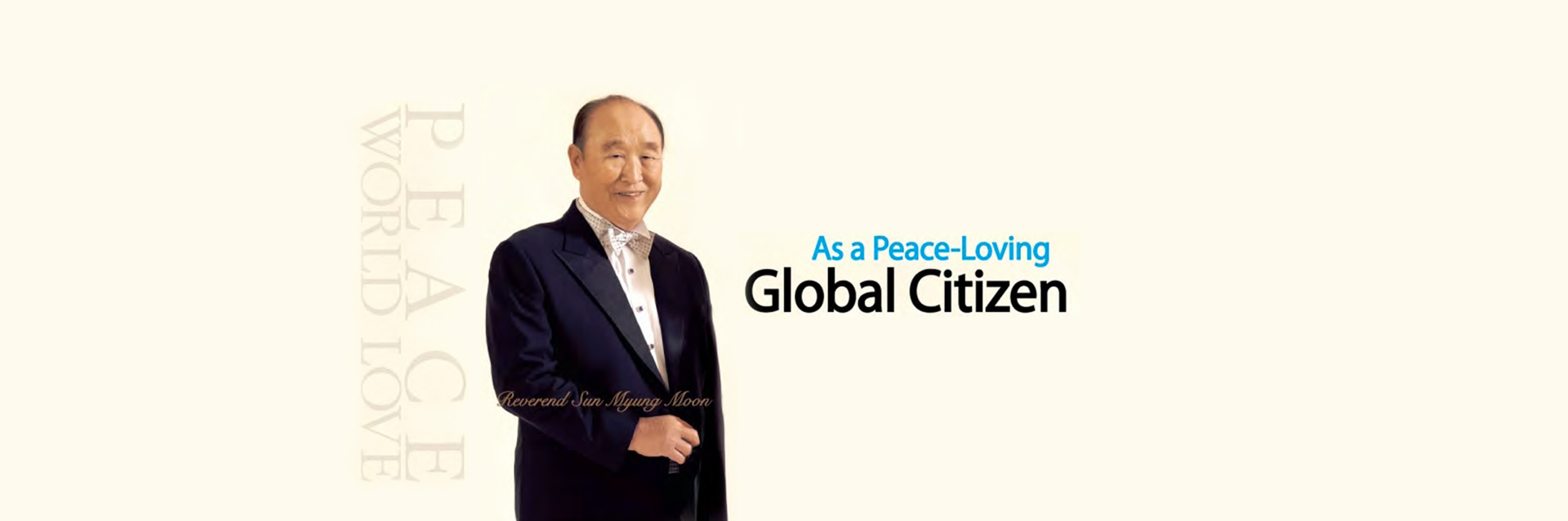
Autobiography: As a Peace-Loving Global Citizen
Chapter 6: Love Will Bring Unification
The Power of Religion to Turn People to Goodness
On August 2, 1990, Iraqi President Saddam Hussein staged an armed invasion of Kuwait, igniting the possibility of war in the Persian Gulf. This area has long been a tinderbox, and I could see that the world was about to be swept up in the vortex of war. I concluded that Christian and Muslim leaders must meet to stop the conflict, and I acted immediately to do everything I could to stop a war in which innocent people were sure to die.
On October 2 of the same year, I sent members of our church to Cairo to deliver my urgent message of peace to the highest spiritual authorities of the Middle East and the Muslim world. Many wondered why I, a person with no apparent ties to the Middle East, would convene such a meeting, but to me it is simple. I believe every religion should contribute to world peace. A conflict between Christianity and Islam would be far worse than the conflict between democracy and communism. There is nothing more fearful than religious war.
I implored President George H.W. Bush through direct correspondence to avoid war in the Arab world, and instead work to realize Saddam Hussein’s retreat through diplomatic means. President Bush may have thought he was going to war against Iraq, but that is not how Muslims would think. In the mind of Muslims, religion exists in a higher position than the nation-state. I was very concerned that if Iraq were attacked, the Arab world would join in opposition to the United States and the Christian world.
Our emergency conference in Cairo involved top Muslim leaders and grand muftis from nine countries, including the grand muftis of Syria and Yemen. At the core of the meeting was my desperate appeal to the Arab and Muslim world not to support Saddam Hussein’s claim that this was a holy war. Whether the United States won or Iraq won, what good would it do? What value would it have if it meant that bombs rained down, destroying houses, fields, hills, and precious innocent lives?
The Cairo conference was just one of our many peace activities. Every time a crisis arose in the Middle East, our members worked fearlessly, risking their lives at the scenes of danger. For years, throughout the violence and terror in Israel and Palestine, our members, traveling at a moment’s notice, collaborated with major organizations to work for peace.
I am always uneasy sending our members to places where their lives are at risk, but it is unavoidable when working for the cause of peace. I may be in Brazil tilling the soil or visiting refugee camps in Africa, but my heart is constantly drawn to those members who insist on working in the dangerous tinderbox called the Middle East. I pray that peace will come to the world quickly, so I no longer need to ask our members to go to such places of death.
On September 11, 2001, we all felt utter horror when the World Trade Center twin towers in New York City were destroyed by terrorists. Some people said this was the inevitable clash of civilizations between Islam and Christianity. But my view is different. In their purest form, Islam and Christianity are not religions of conflict and confrontation. They both place importance on peace. In my view, it is bigoted to brand all Islam as radical, just as it is bigoted to say that Islam and Christianity are fundamentally different. The essence of religions is the same.
Immediately following the collapse of the towers, I organized religious leaders from New York and around the country to pray and minister to the victims and first responders at Ground Zero. Then, in October, I convened a major interfaith conference for peace in New York City. Ours was the first international gathering in New York after the tragedy.
These dramatic contributions to peace in times of war did not spring up from nothing. For decades, I have invested in promoting interreligious harmony. It is on the foundation of this investment that we have the trust of major faith leaders who would travel to Israel during the Intifada, or to New York in the wake of 9/11.
In 1984, I brought together forty religious scholars, instructing them to compare the teachings that appear in the sacred texts of Christianity, Islam, Buddhism, and other major world religions. The book that resulted from their efforts was World Scripture: A Comparative Anthology of Sacred Texts, published in 1991. What they found was that the sacred texts of religions convey the same or similar teachings more than 70 percent of the time. The remaining 30 percent are teachings that represent unique points of each religion. This means that most of the teachings of the major world religions are the same at their core. On the surface, some believers wear turbans, some wear prayer beads around their necks, others carry the cross, but they all seek the fundamental truths of the universe and try to understand the will of the Creator.
People often become friends even if all they have in common is the same particular hobby. When two strangers meet and discover they have the same hometown, they can immediately communicate as if they had known each other for decades. So, it is truly tragic that religions, which share the same teachings more than 70 percent of the time, still struggle to understand each other and communicate happily. They could talk about the things they have in common and take each other by the hand. Instead, they emphasize their differences and criticize one another. All religions in the world talk about peace and love. Yet they fight each other over peace and love. Israel and Palestine talk of peace and justice, yet both countries practice violence until children are bleeding and dying.
Judaism, the religion of Israel, is a religion of peace, and the same is true of Islam. Our experience when compiling World Scripture leads us to believe that it is not the religions of the world that are in error but the ways the faiths are taught. Bad teaching of faith brings prejudice, and prejudice leads to conflict. Muslims were branded terrorists after the 9/11 attack. But the vast majority of simple, believing families are peace-loving people, just like we.
The late Yasser Arafat led the Palestinians for a long time. Like all political leaders, he had hoped for peace, but he was also associated with strife in the region. As chairman of the Palestine Liberation Organization, Arafat embodied the determination for the Gaza Strip and the West Bank to become an independent Palestinian state. Many argue he shifted from his past associations and began to deter the activities of extremist organizations after he was elected president of the Palestinian National Authority in 1996. In the interest of seeking peace in the Middle East, I communicated with Arafat on twelve separate occasions. Of course, my words never wavered. God’s way is the way of harmony.
The road to Arafat’s office was literally a difficult one. Anyone approaching his office had to pass between heavily armed guards and submit to at least three body searches along the way. But when our members arrived, Arafat, wearing his keffiyeh, would welcome them. These sorts of relationships cannot be built in a day or two. They come from the years when we poured out our sincerity and devotion for the sake of Middle East peace. It was our arduous efforts and constant willingness to risk our lives in terror-ridden conflict areas that prepared the way for us to be welcomed to relationships with the religious and political leaders at these levels. It took large amounts of resources. Finally, we could gain the trust of both Arafat and top Israeli leaders, which allowed us to play a mediating role during outbreaks of conflict in the Middle East.
I first set foot in Jerusalem in 1965. This was before the Six Day War, and Jerusalem was still under Jordan’s territorial control. I went to the Mount of Olives, where Jesus shed tears of blood in prayer just prior to being taken to the court of Pontius Pilate. I put my hand on a 2,000 year-old olive tree that could have witnessed Jesus’ prayer that night. I put three nails in that tree, one for Judaism, one for Christianity, and one for Islam. I prayed for the day when these three families of faith would become one. World peace cannot come unless Judaism, Christianity, and Islam become one. Those three nails are still there.
Judaism, Islam, and Christianity are sharply divided against each other in today’s world, but they share a common root. The issue that keeps them divided is their understanding of Jesus. To address this problem, on May 19, 2003, I asked that we de-emphasize the cross in relations among the Abrahamic faiths. Thus, we enacted a ceremony of taking down the cross. We brought a cross from America, a predominantly Christian culture, and buried it in the Field of Blood in Israel. This is the field that was bought with the thirty pieces of silver that Judas Iscariot received for the betrayal of Jesus that ended in Jesus’ crucifixion.
Later that year, on December 23, some 3,000 Ambassadors for Peace from all religions, and from around the world, joined with 17,000 Israelis and Palestinians in Jerusalem’s Independence Park to symbolically remove the crown of thorns from the head of Jesus and replace it with a crown of peace. These 20,000 then marched for peace through Jerusalem city. Local authorities granted permissions and protected our efforts, and Palestinian families supported our march for peace by placing a light in front of their homes. Through that march, which was broadcast live via the Internet to the entire world, I proclaimed that Jesus had his authority as King of Peace restored to him. After centuries of misunderstanding and division, an opportunity was created for Christianity, Judaism, and Islam to reconcile with one another.
Al-Aqsa Mosque, the third-holiest mosque in Islam after those in Mecca and Medina, is in Jerusalem. It is the spot from which the Prophet Mohammad is said to have ascended to heaven. Ours was the only mixed religious group welcomed to all parts of this house of worship. The mosque leaders guided the Christian and Jewish leaders who had participated in the peace march to the sacred spaces of the mosque. We opened a door that had been closed tightly, and prepared the way for many Muslim leaders to communicate at a new level with their Christian and Jewish brothers and sisters.
Human beings like peace, but they also enjoy conflict. Human beings will take the most gentle of animals and make them fight. They will have roosters stand their crowns on end and peck each other with their sharp beaks until pieces of soft flesh begin to fall away. Then, people will turn around and tell their children, “Don’t fight with your friends. Play nice.” The fundamental reason that wars occur is not religion or race. It is connected to what lies deep inside human beings. People like to attribute the causes of armed conflicts to such things as science or the economy, but the actual fundamental problem lies within human beings ourselves.
Religion’s role is to turn human beings toward goodness and eliminate their evil nature that finds enjoyment in fighting. Examine the major religions of the world. They all hold a peaceful world as their ideal. They all want to see a kingdom of heaven, utopia, or paradise. Religions have different names for this ideal, but they all seek such a world. There are numerous religions in the world, and virtually every one is divided into countless factions and denominations. But the essential hope for all is the same: They want the Kingdom of Heaven and a world of peace. The human heart has been torn to shreds by the violence and enmity at our core. The kingdom of love will heal it.
The River Does Not Reject the Waters That Flow into It
Selfishness is rampant in the world. Ironically, however, the individual is destroyed by this, and not just the individual, but those around him and the nation as a whole. The greatest obstacle to the world of peace is avarice in peoples’ hearts. It starts in individuals, expands to the nation, and hearts stained with avarice cause division and conflict at every level. Countless people throughout history have shed blood and died in conflicts caused by avarice.
To eliminate such conflicts, we need a great revolution to change the erroneous values and thinking that are widespread in the world today. The complex problems our societies face today can be resolved quickly if there is a revolution in peoples’ thinking. If each individual and nation begins to look out for the other first, working together with the other, the problems of modern society will be resolved.
Throughout my life, I dedicated myself to efforts for peace. Anytime the word “peace” comes up, I become emotional. I choke up, it becomes difficult for me to swallow my food and tears begin to well up in my eyes. It moves me deeply just to imagine the day when the world becomes one and begins to enjoy peace. That is the nature of peace. It links people who think differently, are of different races, and speak different languages. Our hearts yearn for this world and harbor a hope that it will be realized. Peace is concrete action; it is not a vague dream.
Building a movement for peace has not always been easy. There have been many difficulties, and it has required large sums of money. I have not done this for my own honor, nor to make money. All I did was invest my full effort, so that we can have a world where a strong and true peace takes root. For as long as I have been doing this work, I have never been lonely. This is because, ultimately, peace is the desire of every person in the world. It is strange, though. Even though everyone wants peace, it has still not come.
It is easy to talk about peace. But to bring peace is not easy. This is because people push aside the most elemental truth needed to bring about a world of peace. They pretend not to know this truth is there. Before we talk about peace among individuals or among nations, we must talk about peace between ourselves and God.
Each religion today thinks of itself as the highest, rejecting and looking down on other religions. It is not right to build fences against other religions and denominations.
A religion is like a wide river flowing toward an ideal, peaceful world. The river flows for long distances before it comes to the wide expanse of peace. On its way, many streams flow into it. The streams cease to be streams from the point they meet the river. From that point, they, too, become part of the river. In this way, they become one.
The river does not reject any of the streams that flow into it. It accepts them all. It embraces all the streams and forms a single flow as it continues toward the ocean. People in the world today do not understand this simple truth. The streams that seek out the river and flow into it are the numerous religions and denominations of today. Each stream traces its origin to a different spring, but they are all going to the same destination. They are seeking the ideal world overflowing with peace.
Peace will never come to this earth unless we first tear down the walls between religions. For thousands of years, religions have grown in alliance with particular ethnic groups, and so they are surrounded by high cultural walls. Tearing these down is an extremely difficult task. For thousands of years, each religion has surrounded itself with such high walls, insisting that it is the only correct religion. In some cases, religions have expanded their influence and entered into conflicts and fights with other religions, using God’s name in places that had nothing to do with His will.
The will of God lies in peace. A world fragmented by differences in nationality, race, and religion, where people attack and fight one another and shed one another’s blood, is not what God wants. When we shed blood and fight each other in His name, we only cause Him pain. A world torn to shreds has been created out of the desires of people to promote their own wealth and glory. It does not represent the will of God. God clearly told me so. I am only His errand boy, receiving His words and carrying them out on Earth.
The path to bring about a world of peace, in which religions and races become united, has been exhausting. Many times, I was rejected by people, or my own abilities fell short, but I could not put aside this mission. When members and colleagues who worked with me would cry out in anguish because of the difficulty of the task, I would even feel envious of them.
“If you decide this path isn’t for you, you have the option to stop and turn back,” I told them. “Or if you try and try and still can’t accomplish it, you have the option to die trying.”
“But you should pity me,” I said. “I am a person with no such options.”
There are some two hundred countries in the world. For all these countries to enjoy peace, the power of religion is absolutely necessary. The power of religion is in the love that overflows from it. I am a religious person whose role is to convey love, so it is natural that I would work for world peace. There is no difference between Islam and Christianity in their commitment to bring about a world of peace. In America, I lead a movement for peace, bringing together twenty thousand clergy who transcend denomination. Through this movement, we discuss ways that Christianity, Islam, Judaism, Buddhism, and all faiths can come together. We devote our full efforts to change the hardened hearts of people.
My purpose is the same today as it was yesterday. It is to create one world with God at the center, a world brought together like a single nation without boundaries. All humanity will be citizens of this world, sharing a culture of love. In such a world, there will be no possibility for division and conflict. This will mark the beginning of a truly peaceful world.
“Allow Freedom of Religion in the Soviet Union”
There are a number of materialism-based theories that are popularly held but not verified. One is Charles Darwin’s theory of evolution. Another such theory comes from the writings of Karl Marx. The idea that spirit originates from matter is wrong down to its root. Human beings are created by God, and all beings are unified bodies having both material and spiritual aspects. In short, the core theory and philosophy underlying communism is wrong. While studying in Japan, I worked together with communists for the independence of Korea. They were my good friends who were prepared to give their lives, if necessary, for the liberation of our homeland; but our way of thinking was fundamentally different. So, once independence was achieved, we had to go our separate ways.
I am opposed to the historical materialism of communism. I have carried out a movement for victory over communism throughout the world. I have advised successive U.S. presidents to protect the free world, standing up to the communist strategy of turning the world red. Communist countries that were unhappy with my actions attempted to remove me through acts of terror, but I do not hate them. Nor do I consider them my enemy. I oppose the philosophy and ideology of communism, but I have never hated its people. God wants even communists to be brought into His oneness.
In that sense, my visit to Moscow in April 1990 for a meeting with President Mikhail Gorbachev and my visit to Pyongyang the next year for a meeting with President Kim Il Sung were not simple journeys; they were taken at the risk of my life. It was my destiny to go on these journeys to convey Heaven’s will to these men. I said only half-jokingly at the time that Moscow, pronounced in English, sounds similar to “must go,” and so I had to go.
I had a long-held conviction regarding communism. I could foresee that signs pointing to the fall of communism would begin to appear after about sixty years from the Bolshevik Revolution, and that the Soviet edifice would fall in 1987, the seventieth anniversary of the revolution. So I was excited in 1984, when I heard that Dr. Morton Kaplan, a noted political scientist at the University of Chicago, was proposing to hold an international conference titled, “The Fall of the Soviet Empire.” I asked him to pay me a visit in Danbury prison so that we could discuss the details. The first thing I said to him when we met was that I wanted him to declare “the end of Soviet communism” before August 15 of that year.
Dr. Kaplan responded, “Declare the end of Soviet communism? How can I do such a risky thing?” and indicated he was not inclined to do this. But, it’s the final flame that burns the brightest. In 1985, the Soviet Union was increasing its worldwide influence, and there were no outward signs of its decline. So it was natural that Dr. Kaplan would be reluctant. If he made a declaration predicting such a specific event and it turned out to be false, his reputation as a scholar could be destroyed overnight.
“Rev. Moon,” he said, “I believe you when you say that Soviet communism will fall. But I don’t think it will happen just yet. So instead of declaring, ‘the end of Soviet communism,’ how about if we say ‘the decline of Soviet communism? ’” I saw, too, that he was proposing to soften the title of his program and use something other than “Fall of the Soviet Empire.”
I burned with anger. These were compromises I could not accept. I felt strongly that if a person had conviction, he should be brave and put out all his energy to fight, even if he feels afraid.
“Dr. Kaplan,” I said, “What do you mean? When I ask you to declare the end of communism, I have a reason. The day you declare the end of communism, it will take energy away from it and help bring about its peaceful collapse. Why are you hesitating?”
In the end, Dr. Kaplan declared “the end of Soviet communism” at a conference of the Professors World Peace Academy (PWPA) held in Geneva under the title, “The Fall of the Soviet Empire: Prospects for Transition to a Post-Soviet World.” It was something that no one had dared consider. Because Switzerland was a neutral country, Geneva was a major staging area for the Soviet Committee for State Security (KGB), and many KGB agents worked from there to carry out espionage and terror activities around the world. The Intercontinental Hotel, where the PWPA conference was held, faced the Soviet embassy across the street, so I can well imagine how much fear Dr. Kaplan must have felt. A few years later, however, he became well-known as the scholar who first predicted the end of Soviet communism.
In April 1990, I convened the World Media Conference held in Moscow. Unexpectedly, the Soviet government gave me head-of-state–level protocol, beginning at the airport. We were transported to the center of Moscow in a police-escorted motorcade. The car that carried me traveled on the yellow section of the road, which was used only by the president and state guests. This happened before the collapse of the Soviet Union. The Soviet government afforded this exceptional treatment to me, an anti-communist.
At the conference, I gave an address praising the move toward perestroika. I said this revolution must be bloodless, and that it must be a revolution of the mind and spirit. The purpose of my visit was to attend the World Media Conference, but my mind was focused on meeting President Gorbachev.
At the time, President Gorbachev was popular within the Soviet Union, following the successes of his perestroika policies. I could have met the U.S. president ten times if I’d wanted to, but meeting President Gorbachev was much more difficult. I was concerned that even one meeting might be difficult to achieve. I had a message to give him, and it was important that I do this in person. He was reforming the Soviet Union, giving rise to the winds of freedom there, but as time passed, the swords of reform were being increasingly pointed at his back. If the situation were left unchecked, he was about to fall into great danger.
I explained, “If he does not meet me, he has no way to catch the wave of heavenly fortune, and if he cannot do that, he will not last long.”
Perhaps President Gorbachev heard this expression of my concern. The next day, he invited me to the Kremlin Palace. I rode in a limousine provided by the Soviet government and entered deep into the Kremlin. On entering the presidential office, my wife and I took our seats, and Cabinet ministers of the Soviet Union took seats next to us. President Gorbachev smiled a big smile and gave us an energetic explanation of the successes of his perestroika policies. Then he showed me into an anteroom, where we met one on one. I used this opportunity to give him the following message.
“Mr. President, you have already achieved much success through perestroika, but that alone will not be sufficient for reform. You need to immediately allow freedom of religion in the Soviet Union. If you try to reform only the material world, without the involvement of God, perestroika will be doomed to fail. Communism is about to end. The only way to save this nation is to allow the freedom of religion. The time is now for you to act with the courage that you have shown in reforming the Soviet Union and become a president of the world who works to bring about world peace.”
President Gorbachev’s face hardened at the mention of religious freedom, as though he had not been expecting this. As one would expect from the man who had allowed the reunification of Germany, however, he quickly relaxed his expression and soberly accepted my words to him. I continued, saying, “South Korea and the Soviet Union should now open diplomatic relations. In that context, please invite South Korean President Roh Tae Woo to visit.” I also explained a list of reasons why it would be good for the two countries to have diplomatic relations. After I had finished all I wanted to say, President Gorbachev made a promise to me with a tone of certitude that I had not heard him express prior to that point.
“I am confident,” he said, “that relations between South Korea and the Soviet Union will develop smoothly. I, too, believe that political stability and the relaxation of tensions on the Korean peninsula is necessary. Opening diplomatic relations with South Korea is only a matter of time; there are no obstacles. As you suggested, I will meet President Roh Tae Woo.”
As I was about to leave President Gorbachev that day, I took off my watch and put it on his wrist. He seemed a little bewildered that I would treat him as I might an old friend. So I told him firmly, “Each time your reforms face difficulty, please look at this watch and remember your promise to me. If you do that, Heaven will surely open a path for you.”
As he promised me, President Gorbachev met President Roh in San Francisco in June that year for a bilateral summit. Then, on September 30, 1990, South Korea and the Soviet Union signed a historic agreement to open diplomatic relations for the first time in eighty six years. Of course, politics is the job of politicians, and diplomacy is the job of diplomats. Sometimes, though, when a door has been closed for a long time, a religious person who has no interests at stake can be more effective.
Four years later, President and Mrs. Gorbachev visited Seoul, and my wife and I hosted them at our home in the Hannam Dong neighborhood. He had already been removed from power by a coup d’état. Following the coup by anti-reformist forces opposed to perestroika, he had resigned his position as general secretary of the Soviet Communist Party and dissolved the party. As a communist, he had eliminated the Communist Party. The former president and first lady used chopsticks to eat the bulgogi and jabchae we had carefully prepared. When he was served su-jeong-gwa as dessert, Mr. Gorbachev repeated several times, “Korea has excellent traditional foods.” He and the first lady appeared quite different from the days when he was in office. Mrs. Gorbachev, who had previously been a thoroughgoing Marxist-Leninist lecturing at Moscow State University, wore a necklace with a crucifix.
“Mr. President, you did a great thing,” I told him. “You gave up your post as general secretary of the Soviet Union, but now you have become the president of peace. Because of your wisdom and courage, we now have the possibility to bring world peace. You did the most important, eternal, and beautiful thing for the world. You are a hero of peace who did God’s work. The name that will be remembered forever in the history of Russia will not be ‘Marx,’ ‘Lenin,’ or ‘Stalin.’ It will only be ‘Mikhail Gorbachev.’”
I gave high praise to the decision by Mr. Gorbachev to bring about the breakup of the Soviet Union, the mother country of communism, without shedding blood.
In response, Mr. Gorbachev said, “Rev. Moon, I have been greatly comforted by your words. Hearing your words gives me energy. I will devote the remainder of my life to projects that are for the sake of world peace.” And he firmly took my hand in his.
Korea’s Unification Will Bring World Unification
As I was coming out of the Kremlin Palace after meeting Mr. Gorbachev, I turned to Bo Hi Pak, who had accompanied me, and gave him a special instruction.
“I need to meet President Kim Il Sung before the end of 1991,” I told him. “There’s no time. The Soviet Union is going to end in the next year or two. Our country is the problem. Somehow, I need to meet President Kim and prevent war from occurring on the Korean peninsula.”
I knew that when the Soviet Union collapsed, most other communist regimes in the world would also fall. North Korea would find itself forced into a corner, and there was no telling what provocation it might commit. North Korea’s obsession with nuclear weapons made the situation even more worrisome. To prevent a war with North Korea, we needed a channel to talk to its leadership, but we had no such channel at that point. Somehow, I needed to meet President Kim and receive his commitment not to strike first against South Korea.
The Korean peninsula is a scaled-down version of the world. If blood were shed on the Korean peninsula, it would be shed in the world. If reconciliation occurred on the peninsula, there would be reconciliation in the world. If the peninsula were unified, this would bring about unification in the world. Beginning in the late 1980s, however, North Korea had been working hard to become a country possessing nuclear weapons. Western countries were saying that they would stage a first strike against North Korea, if necessary. If the situation continued to the extreme, there was no telling what desperate move North Korea might attempt. I knew I somehow needed to open a channel of communication with North Korea.
It was not an easy task. Bo Hi Pak communicated with North Korean Vice Premier Kim Dal Hyun, but North Korea’s response was firmly in the negative.
“The people of North Korea know President Moon only as the ring leader of the international movement for victory over communism,” the vice premier said. “Why would we welcome the leader of a conservative, anti-communist group? A visit to North Korea by President Moon absolutely cannot be permitted.”
Bo Hi Pak did not give up. “President Nixon of the United States was a strong anti-communist,” he reminded the North Korean official. “But he visited China, met Chairman Mao Zedong, and opened diplomatic relations between the United States and China. It was China that profited from this. Until then, China had been branded an aggressor nation, but it is now rising as the central country on the world stage. For North Korea to have international credibility, it should establish a friendship with a worldwide anti-communist such as President Moon.”
Finally, President Kim Il Sung invited my wife and me on November 30, 1991. We were in Hawaii at the time, so we quickly flew to Beijing. While we were waiting in the VIP lounge of Beijing Capital International Airport, which the government of China had arranged for us to use, a representative of the North Korean government came and handed us the official invitation. The official stamp of the Pyongyang government was clearly visible on the document.
“The Democratic People’s Republic of Korea extends an invitation to Mr. Moon Sun Myung of the Unification Church, his wife, and entourage to enter the Republic. Their safety is guaranteed during the period of their stay in the North.”
It was signed “Kim Dal Hyun, Vice Premier, Cabinet of the Democratic People’s Republic of Korea. November 30, 1991.”
Our group boarded a special flight of Air Koryo (aircraft no. JS215) arranged for us by President Kim. A special flight from President Kim had never been arranged for any foreign head of state, so this was very exceptional and special treatment.
The aircraft flew over the Yellow Sea, up to Sin-eui-ju, over my hometown of Jeong-ju, and on to Pyongyang. The special route had been charted to let me see my hometown. My heart began to pound as I looked down at my hometown, dyed red by the light of the set ting sun, and I felt numb deep in my being. I wondered, “Can this really be my hometown?” I wanted to jump out right away and start running around the hills and valleys.
At Pyongyang’s Sunan International Airport, family members whom I had not seen for forty-eight years were there to greet me. My younger sisters, who used to be as beautiful as flowers, had become grandmothers entering their senior years. They grasped my hands, creased their eyebrows, and began to cry wildly. My older sister, now more than seventy, grabbed me by the shoulder and cried. I, however, did not cry.
“Please,” I said, “don’t do this. It’s important for me to meet my family, but I came to do God’s work. Please don’t do this. Get hold of yourselves.”
Inside my heart, I was shedding tears like a waterfall. I was seeing my sisters for the first time in more than forty years, but I could not embrace them and cry with them. I maintained control of my heart, and made my way to our place of lodging.
The next morning, as has been my custom throughout my life, I awoke early in the morning and began to pray. If there were any surveil lance apparatus in the guesthouse, my tearful prayer for the unification of the Korean peninsula would have been recorded in its entirety. That day, we toured the city of Pyongyang. The city was well-fortified with the red slogans of juche ideology.
On the third day of our visit, we boarded an aircraft to tour Mount Kumgang. Though it was the winter season, the Kuryong Falls had not frozen and still spouted a strong flow of water. After touring all the different areas of Mount Kumgang, we boarded a helicopter on our sixth day, to be transported to my hometown. In my dreams, I had felt such a strong yearning for my childhood home that I felt as though I could run to it in one bound. And now, there it was, appearing before me. I could hardly believe my eyes. Was this real, or was I dreaming? For what seemed like the longest time, I could only stand there, like a statue, in front of my home. After several minutes, I stepped inside. It used to be in the shape of a square, with the main wing, guest wing, storehouse, and barn built around a central courtyard. Now, only the main wing remained. I went into the main room, where I had been born, and sat on the floor with my legs crossed. Memories of what it had been like in my childhood came back to me as clearly as if it were only yesterday. I opened the small door that led from the main room to the kitchen and looked out at the backyard. The chestnut tree I used to climb had been cut down and was gone. It seemed as though I could hear my mother calling to me sweetly. “Is my little tiny-eyes hungry?” The cotton cloth of her traditional dress passed quickly before my eyes.
I visited my parents’ grave site and offered a bouquet of flowers. The last time I saw my mother was when she came to visit me in prison in Heungnam and cried out loud. Her grave was thinly covered by the snow that had fallen the night before. I brushed it away with the palm of my hand and gently caressed the grass that had grown over her grave. The rough touch of the grass reminded me of the roughness of my mother’s skin on the back of her hand.
My Meeting with President Kim Il Sung
I had not gone to North Korea because I wanted to see my home town, or because I wanted to tour Mount Kumgang. I wanted to meet President Kim Il Sung and have a serious discussion on the future of our homeland. Yet, six days into my visit, there was no word on whether a meeting with President Kim could be arranged. When we arrived back at Pyongyang’s Sunan Airport by helicopter after visiting my hometown, however, I found that Vice Premier Kim Dal Hyun had unexpectedly come to meet me.
“The Great Leader Kim Il Sung will receive you tomorrow,” he told me. “The place will be the Majeon Presidential Residence in Heung nam, so you will need to board a special flight immediately, and go to Heungnam.”
I thought to myself, “They say he has many presidential residences. Why, of all places, Heungnam?”
On my way, I noticed a large sign for the Heungnam Nitrogen Fertilizer Factory, where I had been forced to labor. It reminded me of my time in prison and gave me an odd feeling. I spent the night in a guesthouse and went the next day to meet the president.
As I approached the official residence, I found President Kim at the entrance, waiting to greet me. The two of us simultaneously embraced each other. I was an anti-communist and he was the leader of a communist party, but ideology and philosophies were not important in the context of our meeting. We were like brothers who were meeting for the first time after a long separation. This was the power of belonging to the same people and sharing the same blood.
Right at the outset, I said to him: “Mr. President, because of your warm consideration, I have been able to meet my family. There are, however, 10 million Koreans who are members of families separated between North and South, and they are unable even to know whether their relatives on the other side are alive or dead. I would like to ask you to grant them the opportunity to meet each other.”
I spent a little more time telling him about my visit to my hometown, and appealed to his love for the Korean people. He and I spoke the same dialect, so we were at ease with one another.
President Kim responded, “I feel the same way. From next year, let’s begin a movement that allows separated compatriots of North and South to meet one another.” His acceptance of my proposal was as natural as the snow melting in spring.
After speaking of my visit to Jeong-ju, I moved on to my views on nuclear weapons. I respectfully proposed that North Korea agree to a declaration on the denuclearization of the Korean peninsula and sign a safeguards agreement with the International Atomic Energy Agency.
President Kim responded with candor, “President Moon. Think for a moment. Who am I going to kill by making nuclear weapons? Kill my own people? Do I look like that kind of person? I agree that nuclear energy should be used only for peaceful purposes. I have listened attentively to what you have to say, and I expect it will be all right.”
At the time, North-South relations were at a difficult point over the issue of nuclear inspections in North Korea, and so I had made my proposal with some reluctance. Everyone present, however, was surprised that President Kim responded in such a pleasant tone. At this point, we adjourned our meeting to a dining room, where we took an early lunch.
“President Moon, are you familiar with ‘frozen potato noodles’? It’s a dish I ate quite often when I was active as a partisan on Mount Baekdu. Please try some.”
“Well, of course I know it,” I said, responding to his words with delight. “We used to enjoy this dish in my hometown.”
“Well, I’m sure in your hometown you ate it as a delicacy,” he continued. “I ate it to survive. The Japanese police used to search for us all the way to the top of Mount Baekdu. We didn’t have a chance to sit down to a decent meal. What else is there to eat at the top of Mount Baekdu other than potatoes?
“We would start to boil some potatoes, and if the Japanese police came after us, we would bury the potatoes in the ground and run away. It would be so cold that by the time we got back, the potatoes would be frozen solid in the ground. The only thing we could do was dig up the potatoes, thaw them, and then turn them into powder, so we could make noodles out of them.”
“Mr. President,” I said, “you are an expert on frozen potato noodles.”
“That’s right. They taste good mixed in bean soup, and they also taste very good if you eat them in sesame soup. It’s a dish that is easy on the digestion, and because potatoes have a tendency to stick together, it is very filling.
“Also, President Moon,” he continued, “it tastes really good if you do like they do in Ham-gyung Province and take some leaf mustard kimchi, like this, and put it over the noodles. You should try it.”
I did as he suggested and ate my frozen potato noodles with some leaf mustard kimchi over them. The tasty flavor of the noodles matched well the spicy kimchi and left my stomach feeling light.
“There are many delicacies in the world,” President Kim said. “I’m not interested in any of those. There’s nothing better than the potato cakes, corn, and sweet potatoes that I used to eat in my hometown.”
“You and I even share similar tastes in food,” I said. “It’s good that people who share the same homeland can meet like this.”
“How was it when you visited your hometown?” he asked me.
“I was filled with many emotions,” I said. “The home where I lived was still there, and I sat in the main room to think about the past. I almost expected to hear the voice of my late mother, calling me. It was an emotional feeling.”
“I see,” he said. “It shows that our country needs to be unified immediately. I hear that when you were young, you were quite mischievous. Did you have a chance to run around while you were there this time?”
Everyone at the table laughed at the president’s comment.
“I wanted to climb a tree and go fishing, but I heard that you were waiting for me, so I quickly came here. I hope you will invite me to come again sometime.”
“Well, of course. Of course I will. President Moon, do you like to hunt? I like hunting very much. I think if you go bear hunting on Mount Baekdu, you will enjoy it very much. Bears have big bodies and look uncoordinated, but they are actually very nimble.
“I once came face to face with a bear,” he continued. “The bear looked at me and didn’t move a muscle. If I had started to run, you know what would have happened, don’t you? So what was I going to do? I stared right back at him and just stood there. One hour passed, then two hours, three hours. But the bear just kept staring at me. You know how Mount Baekdu is famous for being cold. I was afraid I might freeze to death before the bear ate me.”
“So what happened?”
“Well, President Moon, do you see the bear sitting here, or do you see me?”
I laughed out loud, and President Kim immediately followed with a suggestion.
“President Moon,” he said, “the next time you come, let’s go hunting together on Mount Baekdu.”
I responded quickly with my own invitation.
“Mr. President, you like to fish, don’t you? On Kodiak Island in Alaska, you can catch halibut that are as big as bears. Let’s go fishing for those sometime.”
“Halibut as big as bears? Well, I will definitely have to go.”
The two of us were able to communicate well about our shared hobbies of hunting and fishing. At one point, we each felt we had so much to say to the other that we just started talking like old friends meeting after a long separation. Our laughter echoed around the dining room.
I also talked about Mount Kumgang.
“I went to Mount Kumgang, and it really is a beautiful mountain,” I said. “It needs to be developed as a tourism destination for our people.”
“Mount Kumgang will be an asset to our unified homeland,” President Kim said. “So I have made sure that only certain people can touch it. If it’s developed in the wrong way, it could be ruined. You have an international eye, and I could trust someone like you to take it over and develop it for us.”
President Kim went so far as to ask that we develop Mount Kumgang.
“Mr. President,” I said, “you are older than me, so you are like my older brother.”
He responded, “President Moon, from now, let’s refer to each other as older brother and younger brother,” and he grasped my hand tightly.
President Kim and I held each other’s hand as we walked down the hallway and took commemorative photographs. Then I left the residence.
After I had gone, I was told that President Kim told his son, Kim Jong Il, “President Moon is a great man. I have met many people in my life, but none were like him. He has a broad scale of thinking, and he overflows with heart. I felt close to him. It made me feel good to be with him, and I wanted him to stay for a long time. I want to meet him again. After I die, if there are things to discuss pertaining to North-South relations, you must always seek the advice of President Moon.”
So it seemed that we had communicated very well.
Soon after I ended my weeklong stay and left Pyongyang, Prime Minister Hyung Muk Yeon led a North Korean delegation to Seoul. Prime Minister Yon signed an agreement to denuclearize the Korean peninsula. On January 30 of the following year, North Korea signed a nuclear safeguards agreement with the International Atomic Energy Agency, thus fulfilling the commitments that President Kim had made to me. These were the results I accomplished by going to Pyongyang at the risk of my life.
The Land May Be Divided, but Not Its People
The Korean peninsula is one of the last remaining divided countries on earth. We have the responsibility to unify the peninsula. We cannot pass a divided homeland on to our descendants. It is impermissible that a single people should be divided and for peace loving people to be unable to see their parents or siblings. The line that divides North and South Korea was drawn by human beings. Land can be divided that way, but not people. That we do not forget each other and continue to yearn for each other even after more than fifty years of separation shows that we are one people.
The Korean people were traditionally known as “people of white clothing,” because of the color of our clothes. White is the symbol of peace. Our people are people of peace. During the time of the Japanese occupation, Koreans, Chinese, and Japanese lived in Manchuria and Siberia, sometimes helping each other and at other times killing each other. During that time, Koreans never carried swords or knives as did the Japanese and Chinese. Instead, we carried flint rocks. Lighting fires in the frozen land of Manchuria and Siberia was a way of protecting life. This is the kind of people we are. We respect Heaven, uphold moral principles, and love peace. Our people shed much blood during the time of the Japanese occupation and the Korean War. This, however, did not bring about the unification of our country or the establishment of a sovereignty of peace. Our country was broken at the waist into two pieces, and half became a dark world of communism.
We need unification to restore the sovereignty of our people. We must end the division between North and South so we can have peace. Only after we first accomplish peaceful unification and restore our sovereignty can we bring peace to the world. The Korean people were created to bring peace to the world. Everything has a name, and names have meaning. The clothes of the “people of white clothing” are easy to see, both by day and night. White is good to use for signs during the night because it is easy to see in the dark. Our people are destined to convey messages of peace around the world, both day and night.
North and South are divided by a cease-fire line, but this is not the problem. Once we remove that line, we will find an even larger barrier between us and Russia and China. For our people to enjoy true peace, we will need to overcome those cease-fire lines as well. It will be difficult, but it is not impossible. The important thing is our own attitude.
I believe that when a person sweats, he should sweat every last drop that he has in him. He should sweat even the last little bit that is in his heart. That way, he will have no regrets, and everything will become clean and set in order. The same is true when we attempt anything difficult. The difficulty will end only when you have gained victory at every stage, and everything has been made clear. Whatever you are dealing with needs to be completely put in order. Then it can bear fruit. We can not restore our people’s full sovereignty without going through such tearful difficulties.
Today, many people talk about peaceful unification. I, however, spoke about this at a time when people did not dare even use the phrase “peaceful unification,” for fear of being charged with violating the Anti Communist Law and the National Security Law. Today, when people ask me what must be done to bring about unification, I tell them what I have always said on this matter: “If South Koreans love North Korea more than they love the South, and North Koreans love South Korea more than they love the North, we could unify the peninsula today.”
I was able to risk my life to go to North Korea in 1991 and meet President Kim because I had a foundation of such love within me. I made agreements then with him regarding meetings of separated families, North-South economic cooperation, development of Mount Kum gang, denuclearization of the Korean peninsula, and working toward a North-South summit conference. No one thought an anti-communist could go to a communist country and open the floodgate of unification, but I surprised the world.
Before my meeting with President Kim, I delivered a two-hour address titled “Blood Is Thicker Than Water,” at the Mansudae Assembly Hall, seat of the Supreme People’s Assembly, North Korea’s legislature. I spoke that day to the leadership of North Korea about a way to unify North and South through love. I stood before the leadership of North Korea, who were armed with Kim Il Sung’s philosophy, and told them exactly what I believed.
“North and South must be unified,” I said, “but guns and swords will not make us one. North-South unification will not happen with military force. Even the Korean War failed in this respect, and it is fool ish for anyone to think they can make another attempt through military force. Neither will unification happen with the juche ideology that you espouse. What will do it, then? The world does not operate only by the power of human beings. Because God exists, nothing can be done by human effort alone. Even in situations of evil, such as war, God carries out His providence. That is why North and South cannot be unified through the juche ideology that puts man at the center.
“Bringing about a unified homeland can be done only with Godism,” I continued. “God is protecting us, and our time of unification is coming. Unification is the destiny; it is the task that must be accomplished in our era. If we cannot accomplish the sacred task of unifying the homeland in our time, we will not be able to hold our heads high in the presence of our ancestors or descendants for the rest of eternity.
“What is Godism? It is the practice of God’s perfect love. Neither the right wing nor the left wing can unify North and South. It will be possible only when there is a ‘headwing thought’ that is able to harmonize these two.
“To travel the path of love, you must apologize before the world for your invasion of the South. I understand that North Korea has planted twenty thousand resident espionage agents in the South. Send an order immediately to all of them, instructing them to turn themselves in to the South Korean authorities. If you do that, I will give them an education that will rectify their ideology and turn them into patriots who will contribute to the peaceful unification of North and South.”
I pounded on the table in front of me as I spoke. The expressions of Mr. Yun Ki Bok and Vice Premier Kim Dal Hyun grew tense with fear. I was aware of what dangers I might be exposed to for making such statements, but I needed to say what I had come to say. I was not simply trying to shock the audience. I knew that my speech would be reported immediately, word for word, to President Kim and his son, Chairman Kim Jong Il. So I wanted to state my purpose clearly.
When I finished, some of the North Koreans present even protested, demanding to know how I could dare to speak in such a manner. I looked at my entourage and saw that their faces were white with fear.
Our members who were with me told me: “The speech had a very strong tone, and the atmosphere of the audience was not good.” I was adamant, however.
“Why did I come here?” I asked them. “I didn’t come to see the land of North Korea. If I were to leave here without saying what needed to be said, Heaven would punish me. Even if today’s speech is used by them as an excuse to deny me a meeting with President Kim and to expel us from the country, I still needed to say what I came to say.”
On July 8, 1994, President Kim suddenly died. His death came when North-South relations were at an all-time low. Patriot missiles had been deployed on South Korean soil, and war hawks in the United States advocated the destruction of nuclear facilities in Yongbyon. It appeared that war might break out at any time. North Korea announced it would not receive any mourners from outside the country, but I felt it was important we send someone. I wanted to fulfill my obligation, as I had formed a brotherly relationship with President Kim.
I called Bo Hi Pak. “Go immediately to North Korea as my representative to mourn President Kim’s death.” I said.
“No one can get into North Korea now,” he said.
“I know it’s difficult, but somehow you have to go. I don’t care if you have to swim across the Yalu River. Get in there and convey my condolences.”
Bo Hi Pak first traveled to Beijing and risked his life to communicate with North Korea. Then, Chairman Kim Jong Il gave the instruction, “An exception will be made for a mourning representative from President Moon. Escort him to Pyongyang.”
After condolences had been expressed, Chairman Kim Jong Il met with Bo Hi Pak and politely greeted him, saying, “My father always said that President Moon was working hard for the unification of our homeland. I am glad you came.”
In 1994, the Korean peninsula was in such a crisis that it could have exploded at any time. In that moment, we were able to resolve the nuclear crisis on the Korean peninsula because of the relationship I had formed with President Kim Il Sung. Sending a representative to express my condolences was not a simple matter of mourning.
I described my meeting with President Kim in considerable detail to illustrate my point about the importance of faith and loyalty between two people. I met him for the sake of the peaceful unification of our homeland. I was able to convey my concerns for the destiny of our people with faith and loyalty. As a result, after his death, his son, Chair man Kim Jong Il, accepted our mourning representative. There is no wall that cannot be scaled and no dream that cannot be realized when we share our love with a sincere heart.
When I went to North Korea, I thought of it as my homeland and the home of my brother. I didn’t go there with a desire to get something from them. I went with the purpose to share with them my heart of love. The power of love touched not only President Kim Il Sung but also his son, Chairman Kim Jong Il. Since then, and continuing to this day, we have maintained a special relationship with North Korea. Each time North-South relations become difficult, we have played a role in opening the gateway. It is all based on the fact that I met with President Kim Il Sung, conveyed to him my sincere heart, and built a relationship of trust with him. That is the importance of trust.
Following my meeting with President Kim, we now operate the Pyonghwa Motors plant, the Potonggang Hotel, and the World Peace Center in North Korea. There are eight billboards for Pyonghwa Motors around Pyongyang. When the South Korean president visited North Korea, North Korean officials took him to the Pyonghwa Motors plant. South Korean business leaders who accompanied the president stayed at the Potonggang Hotel. Non-North Korean members of our church who work in North Korea gather at the World Peace Center each Sunday for worship service. All of these projects are efforts for the sake of peace ful exchanges and unification of North and South. They are not being done to make a profit. They are efforts to contribute to the unification of North and South as an expression of love for the Korean people.
Not by Guns or Swords, but by True Love
It is not just the cease-fire line that divides our people. The Young nam and Honam regions are also divided by an invisible line. Also, Koreans who live in Japan are divided between the Korean Residents Union in Japan, or Mindan, which has ties to South Korea, and the General Association of Korean Residents in Japan, or Chon gryon, which has ties to North Korea. The conflict between the two organizations in Japan is based on the hometowns of their respective members. Second- and third-generation Korean residents in Japan, who have never been to their parents’ hometowns, still live in conflict with each other, as they live within the lines drawn by their parents. The members of the two organizations use slightly different language, send their children to different schools, and do not intermarry.
In 2005, I put into effect my long-held plan to create oneness among Koreans in Japan, as well as among Koreans in the Youngnam and Honam regions. I invited one thousand members of Mindan and one thousand members of Chongryon to Seoul, and matched them in sisterhood and brotherhood relationships to one thousand people from the Youngnam region and one thousand people from the Honam region. It is next to impossible for Chongryon and Mindan to sit down together in Japan and talk about the peaceful unification of North and South. The task of gathering these people in one place was difficult, but it was deeply moving for me to see them sitting together and embracing each other. One Chongryon official at the event was visiting Seoul for the first time. He spoke in tears as he commented that he deeply regretted the many years he had spent fighting a war that was not his own, particularly as he was not even certain which part of the peninsula his father actually came from. He said he felt immeasurably ashamed for having lived his life with a meaningless line of division drawn in his heart.
To fully understand the division of the Korean peninsula and the conflict between the two sides, we must be able to look comprehensively at the past, present, and future. Every incident has a root cause. The division of the Korean peninsula was created by the history of struggle between good and evil. When the Korean War broke out, the Soviet Union, China, and other communist countries came to the aid of North Korea. In a similar way, sixteen countries, led by the United States, sent armed forces to the aid of South Korea. Also, five countries sent medical teams, and twenty nations provided war supplies. What other war in history involved so many countries in the fighting? The reason that the entire world became involved in a war that took place in the tiny country of Korea is that this was a proxy war between the forces of communism and the forces of freedom. It could be said that Korea came to represent the world, and that good and evil fought fiercely on its soil.
Retired general and former U.S. secretary of state Alexander Haig made an unexpected statement in his congratulatory remarks at the tenth anniversary of The Washington Times, celebrated in 1992.
“I am a veteran of the Korean War,” he said. “As a commander, I was in charge of the attack against Heungnam, and we staged the strongest attack we could. I am deeply moved to hear that Reverend Moon was being held by the communists and was set free by that day’s attack. It seems I was sent there to free Reverend Moon. Now, Reverend Moon is here to save America. The Washington Times is a newspaper that will save the American people by providing a balanced view of history that is neither right nor left, and show us the way forward. As we see, there is no such thing as coincidence in history.”
A few years ago in Korea, there were people making the argument that the famous statue of General Douglas MacArthur in an Incheon park should be removed. If United Nations Forces had not joined the war effort, the country would not be divided between North and South, as it is today, this argument went. I was shocked to hear this. Such an argument can only be made from the position of the communist party of North Korea.
Great sacrifices were made on a global level, and yet the peninsula remains divided. We do not know the exact date when unification will come, but it is clear that we are making strong strides in that direction. There are many obstacles to be overcome on the road to unification. As we come face to face with each obstacle, we need to work to tear it down and then move on. Though it may take a long time and prove difficult, unification will absolutely come if we work with the same desperation we would have if we were swimming across the Yalu River.
Following the breakup of the Soviet Union, Romania resisted change the longest among the communist countries of Central and Eastern Europe. Then, at the end of 1989, Romania experienced a bloody uprising by its people. As soon as the regime was toppled, Nicolae Ceauşescu, who had ruled the country for twenty-four years, was executed, along with his wife. He was a brutal dictator who mercilessly massacred those who opposed his policies. In any country, one reason a dictator will tend to tighten his grip is that he fears for his life in the event he may lose power. I think that if a dictator can be certain that his own life will not be placed in danger, he will not go headlong down a dead-end street in the manner of Ceauşescu.
Our country, too, will be unified before long, by one means or another. So politicians and economists need to make the necessary preparations in their own fields of expertise. As a religious person, I will work hard to prepare to greet the unified Korea in which we can embrace North Korean people with love and share in a common peace.
I have studied the unification of Germany for a long time. I have listened to the experiences of those who were involved with regard to how it was that unification could come without a single bullet being fired or a single drop of blood being spilled. In so doing, my hope has been to find a way that is appropriate for Korea. I have learned that the main reason Germany could be unified peacefully was that East German leaders were made to understand that their lives would not be in danger following unification. If East German leaders had not believed this would be so, they would not have allowed unification to occur so easily.
I came to believe we need to give a similar understanding toward the rulers of North Korea. A novel based on North Korea was published in Japan not long ago. In this fictional novel, the rulers of North Korea repeatedly watch a video of Ceauşescu’s execution and cry out, “That is what will happen to us if we lose power. Under no circumstances can we lose our hold on power!” Of course, that is only a novel published in Japan. We should, however, devote our attention to this real problem and find a solution for North Korean leaders, to bring about Korea’s speedy unification.
Building a world of peace on the Korean peninsula is not as difficult as we may think. When South Korea lives fully for the sake of North Korea, North Korea will not try to fight the South, and peace will come naturally to the peninsula. The power that can move a rebellious child is not the fist or brute power. It is the power of love that wells up naturally from within the heart. More than rice or fertilizer, it is important for us to give love to North Korea. We must never forget that it is only when we consider North Korea’s situation and live for its sake with a loving and sincere heart that the North will open its heart to us and the world.