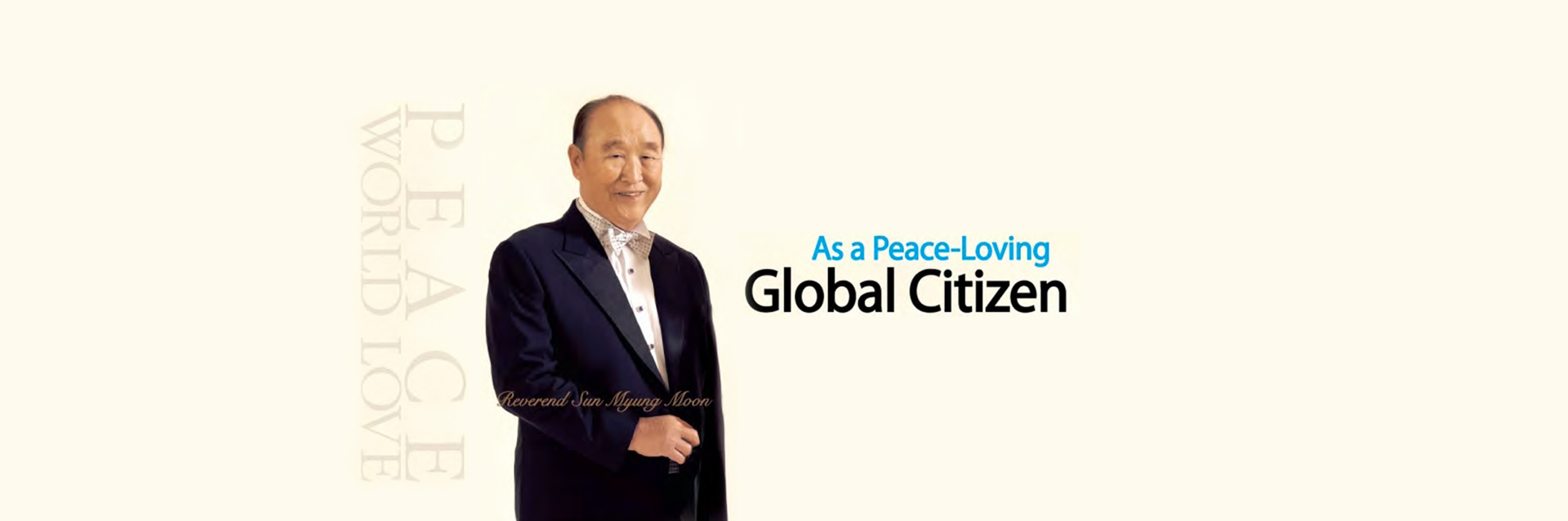
Autobiography: As a Peace-Loving Global Citizen
Chapter 8: Message for the Young People
Find Your Purpose, Change Your Life
When we meet someone new, we are always curious about who he or she is. God has the same curiosity about each human being. He is especially curious about young people, and it brings Him great joy when He gets to know them intimately. Why is this? It is because our youth is the most important and most beautiful period of our lives. This period should be a time of tranquility as one prepares for the future. The process of growing to maturity is a building block that opens the way to a new era.
It is difficult to find young people today who are passionate about their lives. We find so many young people who, with no goal or purpose for their life, are just wandering around. All great leaders in history had a definite sense of purpose in life from the time they were children. From childhood they nurtured that purpose held within their hearts and exerted great energy to achieve it. Whether they were sleeping or playing with their friends, every youthful action of these great leaders was geared toward preparing for the stage that they would stand on in the future. Is that how you are living your life?
We were all created to be great men and women. God did not send us into this world without purpose. When God created us He invested His complete love into each person. So we were all created for greatness. Because God exists, we can accomplish anything.
I became a completely different person when I began to love God. I loved humanity more than myself and was more concerned with the problems of others than the problems of my family. I loved everything that God created. I deeply loved the trees on the hills and the fish in the waters. My spiritual senses developed so I could discern God’s handiwork in all things of creation.
As I was changing my heart to conform to God’s love, I also strengthened my body so that I could fulfill my mission. I wanted to be ready to go anywhere, anytime that God called on me. I played soccer and did boxing, some traditional Korean martial arts, and wonhwado, a form of martial arts that I developed. In wonhwado the athlete moves his body in a smooth circular motion, almost as in a dance. It is based on the principle that greater power comes from circular motion than moving in a straight line.
Even now I begin each day with stretching exercises for my muscles and joints and a breathing exercise that I developed. Sometimes when I am traveling around the world on speaking tours, I may not have time for these exercises in the morning. Still I will find the time, sometimes while sitting on the toilet. I never miss a day of exercise. When I was young, thirty minutes a day was plenty, but now that I am older I have increased it to an hour a day.
In 2008 I was involved in a helicopter crash. The helicopter was suddenly surrounded by black rain clouds and in an instant crashed onto a mountainside. The helicopter rolled over, and I was left hanging upside down by my seatbelt. Instinctively I tightly grabbed the arm rests on both sides of my seat. If I had not been so diligent in my exercises, I think I would have broken my hip the instant that I was suspended upside down. The body is the container to hold a healthy spirit. It is important for us to be diligent about training our bodies.
Few students go to school because they like to study. They usually go because their parents tell them to, not because they look forward to studying. As students continue to study, however, they gradually learn to enjoy it. From that point they will start to study on their own and find their own path. This self-developed interest in learning is a sign of maturity.
Parents cannot wait until their children mature enough to study on their own. They tell them, “You have to study. Please make up your mind to study,” and put pressure on them. Parents do this because they know that children need to study in order to prepare for the future. They worry that if their children don’t study at the proper age level, they will face the future unprepared.
There is, however, something more important than studying to prepare for the future. Before unconditionally focusing entirely on studies, young people must realize what they want to do in life. They must make a determination to use their talents to help the world rather than just serve themselves. Many young people today seem to be studying just for its own sake. Unless you have a purpose in life, your studies will lack the passion needed for happiness.
Once I came across a Korean student working hard on his English school work. I asked him, “Why are you working so hard to learn English?”
He answered, “To get into a university.”
What could be more foolish? Getting into a university is not a purpose. A university is a place to go to study particular subjects in the course of pursuing a larger objective. It cannot be the objective itself.
Also, do not define your life goal in terms of how much money you want to make. I have never received a salary, but I managed to eat and stay alive. Money is a means to do something, not the goal. Before you make money, have a plan for spending it. Money gained without a prior objective will soon be wasted.
Your choice of occupation should not be based on just your talents and interests. Whether you become a fire fighter, a farmer, or a soccer player is up to you. But what I am referring to transcends your occupation. What kind of life will you lead as a soccer player? How will you live as a farmer? What is your objective in life?
To set your objective is to give meaning to the life you will lead. If you are going to be a farmer, then you should set your objective to test new agricultural methods, develop better species of crops, and help eradicate world hunger. If you are going to be a soccer player, then set a meaningful objective such as to heighten your country’s image in the world or to establish soccer camps that will nurture the dreams of economically deprived children.
To become a world-class soccer player takes incredible work. If you do not have a definite purpose in your heart, you will not be able to endure the difficult training required to reach the top. Only if you have an objective will you have the power to maintain your course and live a life that is a cut above those around you.
Embrace the World
Setting a goal in life is similar to planting a tree. If you plant a jujube tree in the front yard of your home, you will have jujubes in your home. If you plant apple trees on the hill behind your home, then they will produce apples. Think carefully about your choice of goals and where you intend to plant them. Depending on the goal you choose and where you plant it, you can become a jujube tree in Seoul or an apple tree in Africa. Or you can become a palm tree in the South Pacific. The goal you plant will bear fruit in the future. Think carefully where the best place is to plant your goal so that it will bear the best fruit.
When you are setting your goal, be sure to consider the entire world. Consider Africa, which continues to suffer from poverty and disease. Consider Israel and Palestine, where people continue to aim their weapons at each other and fight over matters of religion. Consider Afghanistan, where people barely keep themselves alive by raising poppy plants used to make harmful drugs. Consider the United States, which has thrown the world’s economy into a pit with its extreme greed and selfishness. Consider Indonesia, which suffers from continued earthquakes and tidal waves. Imagine yourself in the context of those countries, and think which country and which situation would be most appropriate for you. It may be that you are best suited to India, where a new religious conflict may erupt. Or it could be Rwanda, which languishes in drought and hunger.
In setting a goal, students shouldn’t be so foolish as to decide that because a country is small, like Korea, it isn’t worthy of your goals. Depending on what you do, there is no limit to how large a small country can become. Its national boundaries could even disappear. Whether you do good work on the large continent of Africa or in the small country of Korea, your goal should not be restricted by size. Your goals should be about where your talents can have the most impact. So you should think of the world as your stage as you decide what you want to do in life. If you do, you will likely find many more things to do than what you were originally dreaming about. You have only one life to live, so use it to do something that the world needs. You cannot reach the hidden treasure on an island without adventure. Please think beyond your own country, and think of the world as your stage in setting your goal.
During the 1980s, I sent many Korean university students to Japan and the United States. I wanted them to leave Korea, where teargas canisters were exploding almost daily, and let them see a wider world with greater variety. The frog that lives at the bottom of a well does not realize that there is a bigger world outside the well.
I was thinking globally before that word even entered the Korean language. The reason I went to Japan to study was to see a wider world. The reason I planned to work for the Manchuria Electric Company in Hailar, China, and learn the Chinese, Russian, and Mongolian languages, even before Korea was liberated, was to enable me to live as a global citizen. Even now I travel by plane to many places in the world.
If I were to visit a different country every day, it would take more than six months to visit all of them. People live in many countries, and they all live in different circumstances. There are places where there is no water to cook rice with, while other places have too much water. Some places have no electricity, while some countries are not able to consume all the electricity that they produce. There are many examples of how something is lacking in one place but overabundant in another. The problem is there are not enough people focused on equalizing the distribution.
The same is true with raw materials. Some countries have an abundance of coal and iron ore stacked in piles. They don’t even need to dig into the earth. All they need to do is shovel the coal and iron ore from piles that are easily accessed. Korea, however, has a critical shortage of coal and iron ore reserves. To dig out anthracite coal we need to risk our lives to go thousands of feet underground.
Likewise with technology. Africa has many places where bananas grow naturally in abundance, and they could keep people from starving. But there is a lack of technology and lack of access to productive land, so not enough banana plantations are created. Korea’s climate is not suited for growing bananas, and yet we grow bananas. This technology in Korea could be very helpful in solving the problem of poverty in Africa. It is similar to the way that South Korean technology for planting corn has helped relieve starvation in North Korea.
The phrase global leader is now in vogue in Korea. People say they want to become fluent in English and become global leaders. Becoming a global leader, however, is not a matter of a person’s fluency in English. The ability to communicate in English is nothing more than a tool. A true global leader is someone who is able to embrace the world in his own bosom. A person who has no interest in the problems of the world cannot become a global leader, no matter how well he might communicate in English.
To be a global leader a person must think of the world’s problems as his own and have the pioneering spirit that is needed for finding difficult solutions. A person who is attached to a secure and fixed income, or dreams of having a pension after retirement and a comfortable family life, cannot be a global leader. To become a global leader a person must consider the whole world to be his country and all humanity to be his brothers and sisters and not be overly concerned that he does not know what the future may hold for him.
What are siblings? Why did God give us siblings? Siblings symbolize human beings around the world. The experience of loving our brothers and sisters in the family teaches us how to love our fellow countrymen and love humanity. Our love for our own siblings expands in this way. The family whose members love each other is a model of how humanity can live together in harmony. Love among siblings means that one sibling is willing to go hungry, if necessary, so that his brother or sister can eat. A global leader is someone who loves humanity as he loves his own family.
It has been awhile since we first heard the phrase global village. Yet the earth has always been a single community. If a person’s goal in life is to graduate from a university, get a job with a company that will pay him a high salary, and lead a secure life, then that person will have the success of a puppy. But if he dedicates his life to helping refugees in Africa, he will have the success of a lion. The course that is chosen depends on the heart of the individual.
Even at the age of ninety, I continue to travel around the world. I refuse to rest from my mission. The world is like a living organism in that it is always changing. New problems are always arising. I go to the dark corners of the world where these problems exist. These are not the places with beautiful views or comfortable amenities, but I feel happy in places that are dark, difficult, and lonely because that is where I’m fulfilling my mission, my purpose, my goals.
My hope is that Korea will produce global leaders in the true sense. I hope to see more political leaders who will lead the United Nations to fulfill its purpose and more diplomatic leaders who will stop the fighting in areas of conflict. I hope to see someone like Mother Teresa who will take care of those wandering and dying on the streets. I hope to see peace leaders who will take on my mission of pioneering new solutions from the land and sea.
The starting point is to have a dream and a goal. Please have an adventurous and pioneering spirit. Dream dreams that others dare not imagine. Set goals for yourselves that have meaning, and become global leaders who will bring benefit to humankind.
Everything We Have Is Borrowed from Heaven
People say I am one of the richest people in the world, but they don’t know what they are talking about. I have worked hard all my life, but I don’t own so much as a single house in my name. Neither have I placed property in my wife’s name or in the names of my children so as to conceal its true ownership. Every adult Korean has his official stamp that he registers with the government and uses to sign legal documents. I don’t have such a stamp.
You may wonder, then, what benefit I have received from working hard and not eating or sleeping while others ate and slept. I didn’t work so I could be rich. Money has no meaning to me. Any money not used for the sake of humanity, or for the sake of my neighbor who is dying in poverty, is nothing more than a piece of paper. Money earned through hard work should always be used to love the world and carry out projects that benefit the world.
When I send missionaries overseas, I don’t give them a lot of money. Yet they survive wherever they go. It takes very little for us to support ourselves. If we have a sleeping bag, that is enough for us to sleep anywhere. What is important is not how we live but the kind of life we lead. Material affluence is not a condition for happiness. It is sad to me that the phrase to live well has come to be defined in terms of material affluence. To live well means to live a life that has meaning.
I wear a necktie only for worship services or special events. I don’t wear a suit often, either. I generally wear a sweater when I am at home. I sometimes imagine how much money is spent on neckties in Western societies. Necktie pins, dress shirts, and cuff links are very expensive. If everyone stopped buying neckties and used the money instead for the sake of our neighbors who suffer from hunger, the world would be a little bit better place to live. Expensive things are not necessarily the best to have. Imagine what it would be like if the building were on fire. Who would be the first to get out: Me in my sweater or some guy in a tie? I’m always ready to run outside.
Some people might think I take conservation to extremes. I’m not in favor of taking a bath every day. Once every three days is enough. I also don’t wash my socks every day. In the evening, I take off my socks and put them in my back pocket so that I can wear them again the next day. When I am in a hotel, I use only the smallest of the towels that are hanging in the bathroom. I flush the toilet only after I have urinated in it three times. I use only a single square of toilet paper, after folding it in half three times. I don’t care if you call me uncivilized or barbaric for this. The same desire to conserve is true at mealtime. I have no interest in elaborate meals. There may be all sorts of exotic foods and different types of desserts in front of me, but I am not interested in those. I don’t fill my rice bowl completely. It’s enough if it is three-fifths full.
The shoes I prefer most in Korea cost 49,000 won (about $40) at a large discount store. The pants I wear every day are well over five years old. The meal I enjoy the most in America is McDonald’s. Some people call it junk food and don’t eat it, but I like eating at McDonald’s for two reasons. It’s cheap, and it saves time. When I take the children out to eat, we often go to McDonald’s. I don’t know how it came to be known that I often go to McDonald’s, but now the chairman of the McDonald’s Corporation sends me a New Year’s greeting card every year.
The message that I give to our members every year is “Spend money carefully, and conserve on everything.” I tell them they should drink water instead of buying ice cream or soft drinks. I don’t tell them this so they can save money and become rich. I want them to have a conscious ness of conserving in order to help the country and save humanity. We don’t take anything with us when we leave this world. Everyone knows this, and yet for some reason people are desperate to get their hands on as many things as possible. I plan to give away everything I have built up during my life before leaving this world. The Heavenly Kingdom has plenty of treasure, and there is no need to take anything there from this world. When we understand that we are going to a place that is better than where we are now, there is no need to become attached to the things of this world.
There is a song that I have always liked to sing. It’s an old popular song that many Koreans know. Every time I sing this song it sets my heart at ease and tears come to my eyes. It reminds me of my boyhood when I used to lie in the fields near home.
You may say you will give me a crown with platinum and jewels,
But a shirt smelling of dirt and dripping with sweat is worth more.
A pure heart wells up within my bosom,
I can make a flute out of willow leaves,
And the sparrows sing along with my tune.
You may say you will give me enough gold to buy the world,
But an ox that will till the soil in a barley field is worth more.
The buds of hope sprout in my bosom,
I can talk freely with the rabbits,
And the days go by as I play my tune.
Happiness is always waiting for us. The reason we can’t get happiness is that our own desires block the way. As long as our eyes are fixed on our desires, they cannot see the path we should follow. We are so busy trying to pick up the scraps of gold lying on the ground near us that we do not see the huge pile of gold that is a little way up the road. We are so busy stuffing things into our pockets that we don’t realize that there are holes in those pockets. I have not forgotten what it was like to live in Heungnam Prison. Even the most terrible place in this world is more comfortable and more materially abundant than Heungnam Prison. Every object belongs to Heaven. We are only its stewards.
Happiness Is a Life Lived for Others
Children are born from the flesh and blood of their parents. Without parents there would be no children. Yet people in this world shout out for individualism as though they came into this world on their own. Only a person who receives no help whatsoever from anyone at all would have the right to speak of individualism. There is nothing in this world that comes into being for its own sake alone. All created beings are created for one another. I exist for you, and you exist for me.
There is no one as foolish as the selfish person who lives only for his or her own sake. It may appear that a selfish life benefits the individual, but ultimately it is a life of self-destruction. The individual must live for the family, the family for the people, the people for the world, and the world for God.
All the schools I have founded have three mottos. The first is “Live a life that casts no shadows, as if you were under the sun at high noon.” A life without shadows is a life with a clear conscience. When we finish our life here on earth and go to the spirit world, our entire life will unfold before us, as though it were being played back on videotape. Whether we go to heaven or to hell is determined by how we live. So we need to live spotlessly clean lives, casting not even the smallest shadow.
The second motto is “Live shedding sweat for earth, tears for humanity, and blood for heaven.” There are no lies in the blood, sweat, and tears that people shed. There is only truth. There is no meaning, however, in the blood, sweat, and tears that a person sheds for his own sake. This great investment must be shed for the sake of others.
The final motto is “One Family under God!” There is only one God, and all human beings are brothers and sisters. Differences of language, race, and culture account for only 0.1 percent. As human beings, we are 99.9 percent the same.
There are fourteen island countries in the South Pacific. When I visited the Marshall Islands, I asked its president, “This is a beautiful land, but it must still be difficult to lead this country, isn’t it?” The president sighed and replied, “Our population is just sixty thousand, and the land is just two meters (78 inches) above sea level on average. So a wave just one meter (39 inches) high can flood much of the country. Our most serious problem, though, is education. Children of rich families go to America or Europe to be educated and do not return. Children of poor families have no schools from which to receive a good education, so even the brightest child cannot be trained properly for leadership. The concern for an island country such as ours is that we are unable to raise up leaders who will lead us in the future.”
After hearing his lament, I established the High School of the Pacific, in Kona, Hawaii, for the sake of the children of these island countries. This school provides secondary education to children from countries throughout the Pacific and helps them apply to college. We provide round-trip airfare to Hawaii, tuition, board, and even computers so that they can receive the best education. We attach just one condition to receive this education: Once they finish, they must return to their countries and work in the service of their nation and its people. Living for the sake of others requires sacrifices from time to time. Some years ago one of our church missionaries was touring South America when the place he was visiting was hit by a major earthquake. His wife came running to me with her face as white as a sheet.
“What should I do?” she asked with tears in her eyes. “I’m so worried, I don’t know what to do.”
You might be surprised by my response. Instead of patting her on the shoulder and comforting her, I shouted at her, “Are you worried about your husband, or are you worried about how many lives he may be able to save in that disaster area?”
It was natural for her to be concerned for her husband’s safety. But because she was the wife of a missionary, her concerns should have been of a higher order. Rather than pray for her husband’s safety, she should have prayed that her husband could save as many lives as possible.
Nothing exists for its own sake. That is not how God created the world. Man exists for the sake of woman, and woman exists for the sake of man. Nature exists for the sake of humanity, and humanity exists for the sake of nature. All created beings in this world exist for the sake of their counterparts. It is an axiom of Heaven that every being lives for the sake of its partner.
Happiness is possible only in a relationship with a partner. Imagine that some fellow who has lived his life as a singer goes to an uninhabited island and sings as loudly as possible. If there is no one there to hear him, he will not be happy. To realize that we exist for the sake of others is the great achievement that changes our lives. When we realize that our life is not ours alone but is meant to be for the sake of the other, we begin to follow a path different from the one we were on.
Just as singing to yourself will not make you happy, there is no joy without a partner. Even the smallest and most trivial thing can bring you happiness when you do it for another.
Dreaming of a Peaceful World
For years I have called for a world where all religions live together as one, all races live as one, and all nations exist as one. For thousands of years history has seen the continuous increase of divisions. Each time a different religion was adopted or a new regime came into power, more boundaries were drawn and wars were fought. Now, however, we live in an age of globalism. For the sake of the future we must become one.
One way I propose to facilitate that is through the International Peace Highway, a huge undertaking. It will link Korea and Japan by an undersea tunnel and create a bridge across the Bering Strait that separates Russia and North America. These great links can unify the world. When the highway is completed it will be possible to travel by car from Africa’s Cape of Good Hope to Santiago, Chile, and from London to New York. There will be no roadblocks; the entire world will be interconnected as if by capillary vessels.
The world will become one integrated community, and everyone will be able to travel freely across international borders. Borders that give free passage to anyone will lose their significance as borders. Something similar will be true for religion. As the frequency of exchanges among religions increases, greater mutual understanding will arise, conflict will disappear, and the walls of separation will crumble. When different types of people live together in a single global community, barriers between races will come down. Interaction between races will occur despite differences in appearance and language. This cultural revolution will bring the world into one.
The Silk Road was not simply a trade route that people used in order to sell silk and buy spices. It was also a vehicle for the peoples of the East and West to meet and for Buddhism, Islam, and Christianity to meet. These different cultures intermingled and gave rise to a new culture. The International Peace Highway will play a similar role in the twenty first century.
Rome could thrive because all roads led to Rome. This illustrates the importance of roads. When a road is built, people use it to travel. It is used to transport culture and ideology. That is why when a road is built it changes the course of history. When the International Peace Highway is completed, the world can be physically bound together as one. The road will make this possible. I cannot overemphasize the importance of bringing the world together. Some may think that this is an idea ahead of its time. Religious people, however, foresee the future and prepare for it. So it is only natural that we are ahead of our time. The world may not understand us and may cause us to suffer, but religious believers must persevere to lead the way to the future.
Completing the International Peace Highway will require the cooperation of many nations. China, which was a victim of Japanese aggression, may not welcome the idea of being connected to Japan by a highway. Japan and Korea, however, cannot connect to the rest of the world without going through China, so we need to make efforts to win China’s trust. Who will do this? Those of us who will take spiritual own ership over the International Peace Highway in the twenty-first century need to take the lead in this effort.
How about bridging the Bering Strait? It will cost a great deal, but this should not cause concern. The amount of money that the United States has spent in Iraq would be more than enough to build such a bridge. We must stop waging war and forcing people to suffer. It is perverse to start wars and squander hundreds of billions of dollars. The time has come for us to beat our swords into plowshares and our spears into pruning hooks.
The International Peace Highway is a project to bring the world together as one. To become one means more than simply connecting continents by tunnels and bridges. It refers to an equalization of the world’s standards of living. When someone monopolizes a technology and keeps the profit for himself, the balance of the world is upset. The International Peace Highway will rearrange the current inequality by creating access to existing natural and human resources. This will bring about a leveling of wealth. Leveling means that a little is taken off places that are high and added to places that are low. As a result, the two have the same height. This will require sacrifice from those with greater material possessions or knowledge. Building a world of peace cannot be done with one-time charitable acts or donations. Only sincere love and continuous sacrifice is capable of creating a world of peace. We must be willing to offer everything.
Building the International Peace Highway does more than just provide the world with a physical means of communication. Human beings are created so that their mind and body become one. Something similar is true for the world we live in. The world can be completely unified only when there is both physical communication and communication of heart.
The United Nations has done much for world peace. More than sixty years after its founding, however, the United Nations is losing sight of its original purpose and is now an organization that works for the interests of a few powerful countries. The U.N. was created to solve the conflicts that arise in the world, so it must put the world’s interests before the interests of one side or the other. It only leads to further conflict when a powerful country insists on its own way and uses force to pursue it. Unfortunately, the U.N. today is unable to do much about such situations.
In this light, I have proposed a restructuring of the United Nations as a bicameral institution. In addition to the General Assembly there would be a religious, or cultural, assembly or council. This body would consist of respected spiritual leaders in fields such as religion, culture, and education. The members of this interreligious assembly would need to demonstrate an ability to transcend the limited interests of particular religions and cultures and to speak for the spiritual and moral purposes of all humanity. I maintain that the two chambers, working together in mutual respect and cooperation, will be able to make great advances in ushering in a world of peace.
Some may oppose this, saying, “Why should religious people be come involved in world affairs?” My answer is that the world today is in a period when the participation of religious people is crucial. Those who have achieved deep self-awareness through religious practice are needed now more than ever. It is only truly religious people who can stand up to the unrighteousness and evil of the world and practice true love. It is only when the knowledge and experience of political leaders are combined with the wisdom of interreligious leaders that the world will be able to find the path to true peace.
Again today I set out on my path with renewed determination to achieve that goal. My prayer is that every person on earth will be reborn as a peace-loving global citizen, transcending barriers of religion, ideology, and race.